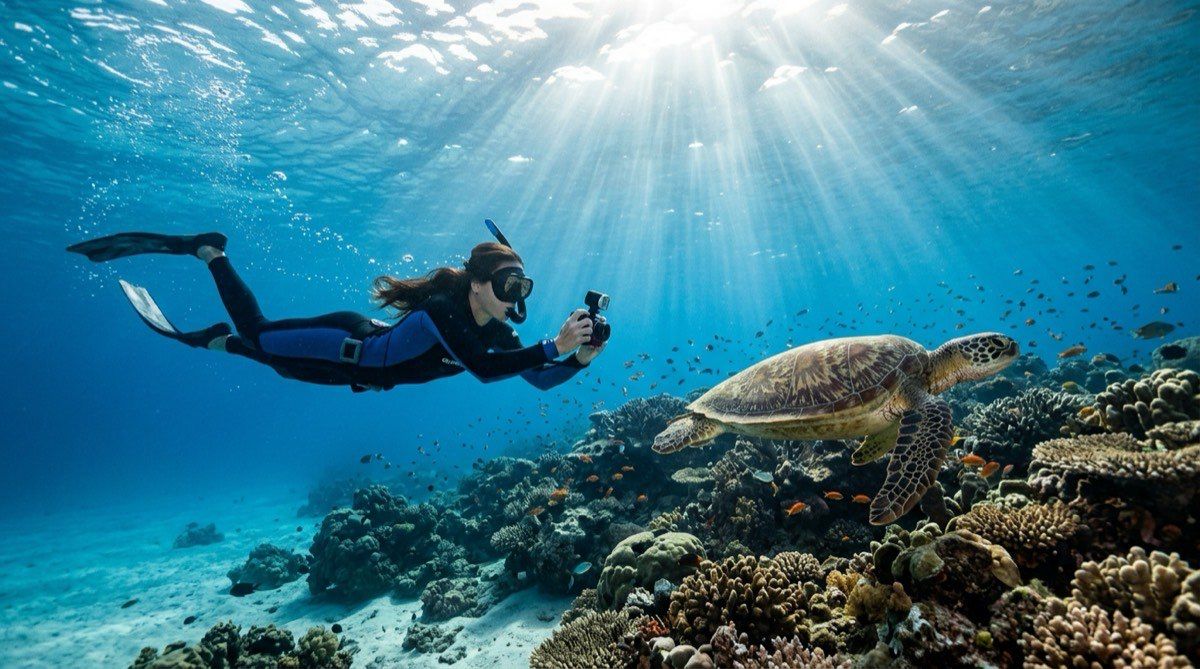
Underwater photography is one of the most rewarding ways to share the magic of the ocean. But shooting photos on a single breath of air presents a unique set of challenges compared to scuba diving.
Without a tank, you don't have unlimited time to compose your shot. However, freediving gives you a massive advantage: you are fast, agile, and completely silent. Because you aren't blowing noisy bubbles, marine life will often let you get much closer.
Whether you are using a simple GoPro or a massive mirrorless rig, here are the essential tips for mastering underwater photography as a freediver.
1. Master Your Diving Skills First
You cannot be a good underwater photographer if you are a stressed freediver.
Before you ever bring a camera down, your breath-hold, duck dive, and finning techniques need to be second nature. If you are struggling to equalize or fighting to stay at depth, adding a camera will only make things worse (and more dangerous). Master your personal diving skills first, so the camera becomes just an extension of your arm.
2. Dial in Your Buoyancy
In scuba diving, you use a BCD (Buoyancy Control Device) to hover effortlessly. In freediving, your buoyancy constantly changes as your lungs compress at depth.
To get a steady shot, you need to understand where your neutral buoyancy point is. If you are trying to photograph a turtle at 5 meters but your neutral buoyancy is set to 10 meters, you will constantly be fighting positive buoyancy, kicking to stay down and ruining the stability of the shot. For shallow shooting sessions, you can adjust your weight belt for the depth you plan to work at—but never dive deeper than your new neutral point, or the ascent becomes a fight. Our guide to neutral buoyancy and freediving weights explains how to test your setup.
3. The Art of the Approach
Marine life is easily startled by fast, aggressive movements. The key to capturing stunning wildlife shots is patience and passive interaction.
Never swim directly at an animal. Instead, execute a smooth, silent duck dive a good distance away, descend to their level (or slightly below them, as shooting upwards creates a more heroic angle), and let them come to you. Keep your hands to yourself: never touch, chase or block the path of turtles, rays or reef fish. Calm animals make better photos. See what you can expect to meet in our guide to Andaman Sea marine life.
4. Understanding Light and Depth
Water absorbs color very quickly. The first color to disappear is red (usually gone by 5 meters), followed by orange and yellow. If you are shooting deep without artificial strobes, everything will look heavily blue or green.
For freedivers shooting with natural light (ambient light), the best photos are taken in the top 10 meters of the water column. Position the sun behind your back to illuminate your subject, or shoot directly upwards toward the sun to capture stunning, dramatic silhouettes.
5. Streamline Your Gear
A massive camera housing with dual strobes creates a massive amount of drag. In freediving, drag kills your breath-hold.
Start small. A GoPro on a short selfie stick or an Insta360 is incredibly hydrodynamic and allows you to focus on your diving. If you move up to a mirrorless camera, keep your setup as compact as possible and tuck it close to your chest during your descent and ascent to minimize water resistance.
Ready to Shoot?
If you want to take your underwater content to the next level, mastering the camera is only half the battle—the other half is mastering your breath. Join our Freediving Photography Workshop to learn hands-on techniques from professionals, or start with a Wave 1 Beginner Course to build a rock-solid diving foundation.