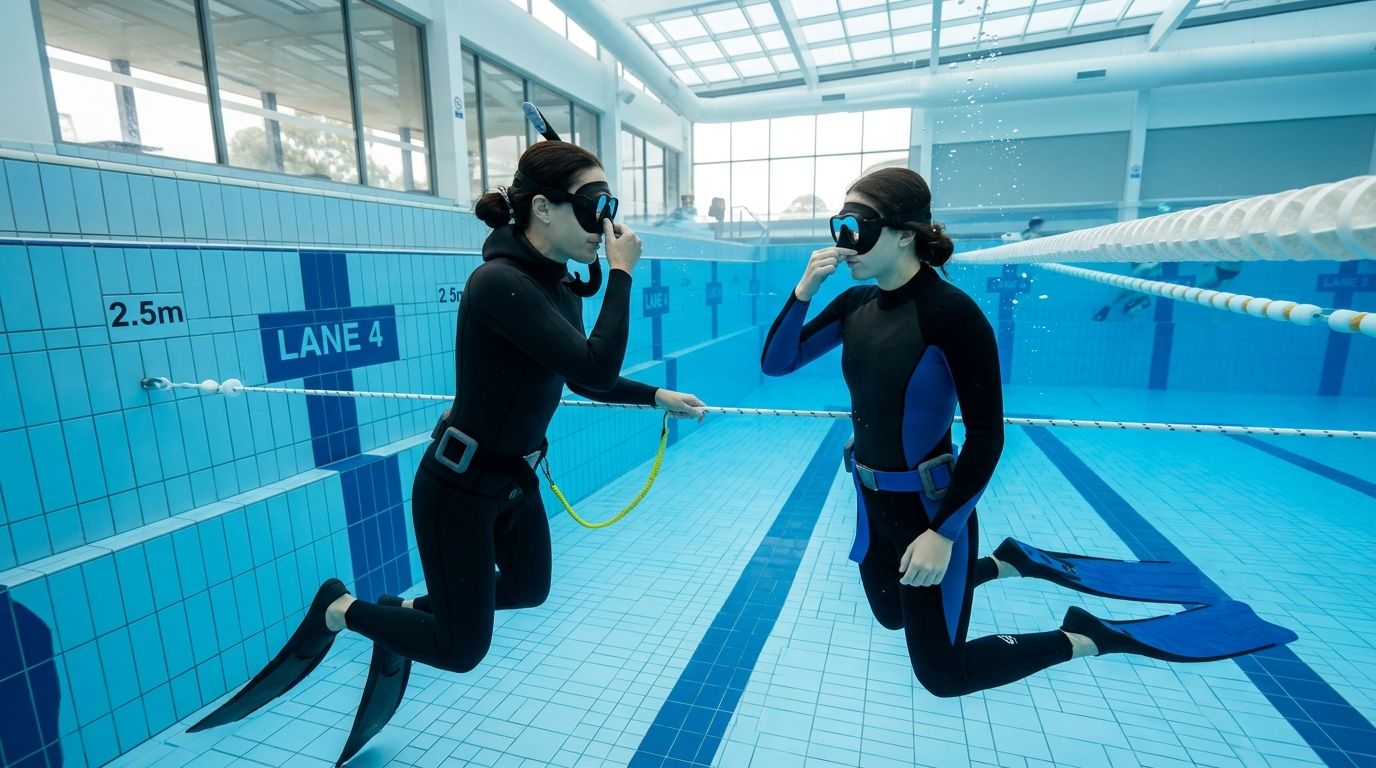
AIDA, Molchanovs, SSI, PADI, CMAS — every school seems to teach a different "system". Here is how the major freediving agencies compare, what each level actually requires, and how to pick the right one for you.
If you search for a freediving course in Phuket, Bali, Dahab or anywhere else, you will quickly run into a wall of acronyms. The good news: the core skills are the same everywhere. Every serious agency teaches relaxation, breathing, equalization, safe technique and — most importantly — buddy rescue. The differences are in structure, materials, recognition and what happens after your first course.
This guide compares the five agencies you are most likely to meet, side by side.
The Five Major Freediving Agencies at a Glance
| Agency | Founded | Background | Best known for |
|---|---|---|---|
| AIDA International | 1992 | Freediving-only federation | World competitions and record rules |
| Molchanovs | 2010s | Freediving-only, founded by Natalia & Alexey Molchanov | Modern training system, app and global community |
| SSI Freediving | 2010s (SSI founded 1970) | Scuba agency with a freediving branch | Digital learning, scuba-diver crossover |
| PADI Freediver | 2015 (PADI founded 1966) | World's largest scuba agency | Huge dive-center network |
| CMAS | 1959 | World underwater federation | Club-based training, mainly in Europe |
AIDA International
AIDA (Association Internationale pour le Développement de l'Apnée) is the oldest freediving-only organization. It writes the rules for most international competitions and ratifies world records. Its education system runs from AIDA 1 (an introduction) to AIDA 4 (Master Freediver), followed by instructor levels.
Strengths: strong reputation, clear standards, the natural choice if you dream of competing. Keep in mind: course quality depends heavily on the individual school, and materials have historically been more traditional.
Molchanovs
Molchanovs was created by Natalia Molchanova — one of the greatest freedivers in history — and her son Alexey Molchanov, a multiple world record holder. The education system has pool-only "Lap" courses and full "Wave" courses (Wave 1–3), followed by Wave 4 (instructor) and higher.
Strengths: a structured training methodology that continues after the course, modern digital materials, and a large international community. Keep in mind: it is younger than AIDA, so you will find fewer Molchanovs schools in some remote destinations.
Read more in our detailed AIDA vs Molchanovs comparison and our guide to Molchanovs certification in Phuket.
SSI Freediving
SSI (Scuba Schools International) offers freediving levels from Basic Freediver to Level 3 (Master), plus pool and specialty programs. Its digital learning app is excellent and free to start.
Strengths: easy for scuba divers already in the SSI system, good e-learning, many dive centers worldwide. Keep in mind: many SSI freediving courses are taught at scuba centers, so check that your instructor is a dedicated freediver.
PADI Freediver
PADI, the largest scuba agency in the world, launched its freediving program in 2015: Basic Freediver (pool only), Freediver, Advanced Freediver and Master Freediver.
Strengths: recognized everywhere, huge network, familiar format for PADI scuba divers. Keep in mind: like SSI, freediving is a side branch of a scuba business, so instructor experience varies a lot.
CMAS
CMAS (Confédération Mondiale des Activités Subaquatiques) is the world underwater federation. Its freediving levels use a star system (1–4 stars) and are usually taught through national federations and local clubs, especially in Europe. CMAS also organizes its own world freediving championships.
Strengths: club culture, affordable training at home, official sports federation status in many countries. Keep in mind: it is less common in tourist destinations such as Thailand.
Course Levels and Requirements Compared
Here is roughly how the main levels line up. Numbers are typical minimum performance requirements; each agency updates its standards from time to time, so your instructor will confirm the current ones.
| Level | Static apnea | Dynamic (pool) | Depth (open water) |
|---|---|---|---|
| Beginner — AIDA 2 / Molchanovs Wave 1 / SSI Level 1 / PADI Freediver | 1:30–2:00 | 25–40 m | 10–20 m |
| Intermediate — AIDA 3 / Molchanovs Wave 2 / SSI Level 2 / PADI Advanced | 2:30–2:45 | 50–55 m | 20–30 m |
| Advanced — AIDA 4 / Molchanovs Wave 3 / SSI Level 3 / PADI Master | 3:30 | 70–75 m | 32–40 m |
Beginner level, agency by agency:
- AIDA 2: around 2:00 static, 40 m dynamic, a constant weight dive in the 12–20 m range, plus a theory exam.
- Molchanovs Wave 1: 1:30 static, 30 m dynamic, constant weight and free immersion dives to 12–20 m, and a rescue from depth.
- SSI Level 1: 30 m dynamic with bi-fins and a constant weight dive of at least 10 m (certified to 20 m).
- PADI Freediver: 1:30 static, 25 m dynamic and dives to around 10 m.
Two things stand out. First, the beginner courses are very similar in content: you will learn the same breathing, duck dive, finning, equalization and rescue skills. Second, the depth limits are close — every agency certifies beginners to roughly 20 meters.
Can You Switch Between Agencies?
Yes. Most freediving schools accept equivalent certifications from other recognized agencies, often through a short "crossover" assessment. A PADI Freediver can usually join an AIDA 3 or Molchanovs Wave 2 course, and vice versa. Your skills matter more than the logo on your card — a good instructor will check your technique and rescue skills before taking you deeper either way.
The exception is competitions: to compete in AIDA or CMAS events, you will need to register with that federation (a certification from another agency usually does not block you, but competition rules differ).
Which Freediving Agency Should You Choose?
There is no single "best" agency. Use your goal to decide:
- You want to try freediving once on holiday: don't worry about the agency. Take a trial freediving session and see if you love it.
- You already dive with PADI or SSI: their freediving courses fit neatly into your existing account and app. Just make sure the instructor is a specialist freediver.
- You dream of competing: AIDA is the main competition federation (CMAS also runs championships). An AIDA certification gives you the most direct path to competitions and judging.
- You want to keep training and progressing: Molchanovs has the most complete training system after the course — structured programs, a training app and a community of clubs and coaches worldwide.
- You live in Europe and want a local club: a CMAS club near home can be the most affordable way to train year-round.
What Matters More Than the Agency
Whatever you choose, these factors have a much bigger impact on your safety and progress:
- Your instructor: a full-time freediving instructor with real depth experience beats any logo.
- Student-to-instructor ratio: in the water, aim for no more than 4 students per instructor (smaller is better).
- Safety culture: every dive should follow the buddy system. Read our freediving safety rules to know what good practice looks like.
- Conditions: warm, clear, calm water makes learning much easier. That is one reason Phuket is so popular — see the best time to freedive in Phuket.
- Price transparency: check what is included (boat, gear, certification fee). Our freediving cost guide explains typical prices.
Why We Teach Molchanovs in Phuket
At our school, we teach the Molchanovs system because it continues long after your certification. Once you complete Molchanovs Wave 1, you get access to structured training methods for the pool, the gym and the ocean, and a clear path to Wave 2 and Wave 3. Already certified with AIDA, SSI or PADI? You are welcome to continue with us at the matching level.
FAQ
Which freediving certification is the most recognized?
AIDA, Molchanovs, SSI and PADI are all recognized internationally. Freediving schools around the world generally accept any of them as proof of your level.
Is AIDA 2 the same as Molchanovs Wave 1?
They are equivalent beginner levels. Both certify you to around 20 meters with a buddy and cover the same core skills, including rescue.
Is PADI or SSI good for freediving?
Yes, as long as your instructor is an experienced freediver. The agency standards are solid; quality depends on who teaches you.
How long does a beginner freediving course take?
Usually 2–3 days, combining theory, pool and open water sessions. Read what to expect from your first freediving course.