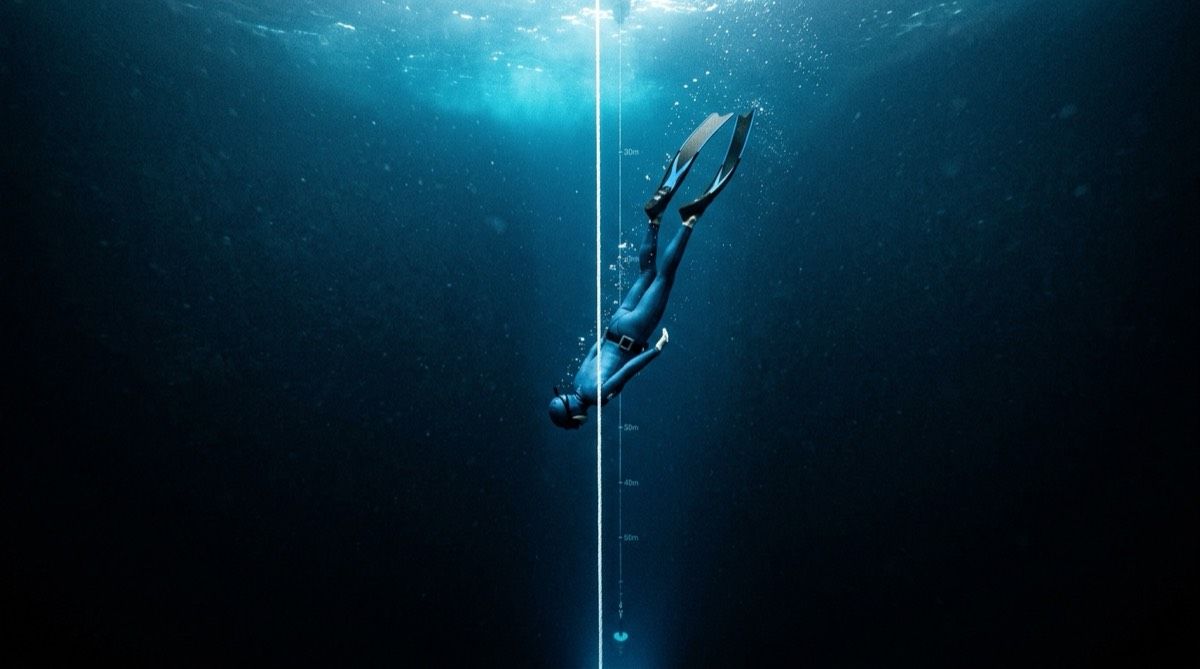
Humans have always been fascinated by the abyss. For decades, scientists and doctors believed there was a hard physiological limit to how deep a human could dive on a single breath. They theorized that past 50 meters, the immense pressure of the ocean would physically crush the human lungs.
Today's freedivers have proven those early scientists entirely wrong. So, just how deep can a human actually go on a single breath, and how does the body survive it?
The Current Limits of Human Depth
When discussing freediving records, it is important to distinguish between the different disciplines.
- No Limits (NLT): This is the absolute deepest a human has ever gone. The diver uses a heavy weighted sled to descend and a buoyant lift bag to return to the surface. The current world record is held by Austrian diver Herbert Nitsch, who reached a staggering 214 meters (702 feet) in 2007.
- Constant Weight (CWT): This is the most prestigious competitive discipline, where the diver swims down and back up under their own power using a monofin. Champions like Alexey Molchanov have pushed this record beyond 130 meters (426 feet).
- Constant Weight No Fins (CNF): The purest discipline—no fins, just a breaststroke-style kick and arm pull. Records here sit around the 100-meter mark.
Want to understand the federations that ratify these records? Read our comparison of AIDA vs. Molchanovs.
To put this into perspective, 130 meters is roughly the height of a 40-story building, and at that depth, the pressure is 14 times greater than at the surface.
The Science of Survival: The Blood Shift
How do freedivers survive depths that should theoretically crush their lungs? The answer lies in an incredible evolutionary adaptation called the Mammalian Dive Reflex, and specifically a phenomenon known as the Blood Shift.
As a freediver descends, the surrounding water pressure increases, compressing the air spaces inside the body. At extreme depths, the lungs shrink down to the size of small grapefruits. To prevent the chest walls from collapsing inward under this pressure, the body instinctively pulls blood away from the extremities (arms and legs) and pools it into the blood vessels surrounding the lungs.
Because liquid cannot be compressed, this wall of blood acts as a protective shield, maintaining the volume of the chest cavity and preventing the lungs from being crushed. As the diver ascends, the blood simply flows back to the rest of the body. It is a brilliant, built-in survival mechanism that humans share with dolphins and whales. Some people take it even further: the Bajau "sea nomads" have genetic adaptations for diving.
The blood shift has limits, though. Descending too fast or too deep without adaptation can injure the lungs—read about lung squeeze to understand why depth is built up gradually.
What Does This Mean for You?
Hearing about 214-meter dives can make freediving sound incredibly intimidating. But it's important to remember that these athletes are the absolute elite, training for years to reach those depths.
For a recreational freediver, the goals are completely different. In a Wave 1 Beginner Course, your target depth is a comfortable 12 to 20 meters. At this depth, you get to experience a mild version of the Mammalian Dive Reflex—your heart rate will slow down, and you will feel a profound sense of peace and relaxation.
You don't need to be a superhuman world record holder to enjoy freediving. Your body is already biologically designed to dive. You just need the right training to unlock it. Start with our step-by-step guide on how to start freediving.